New Oscilloscope
July 19, 2025
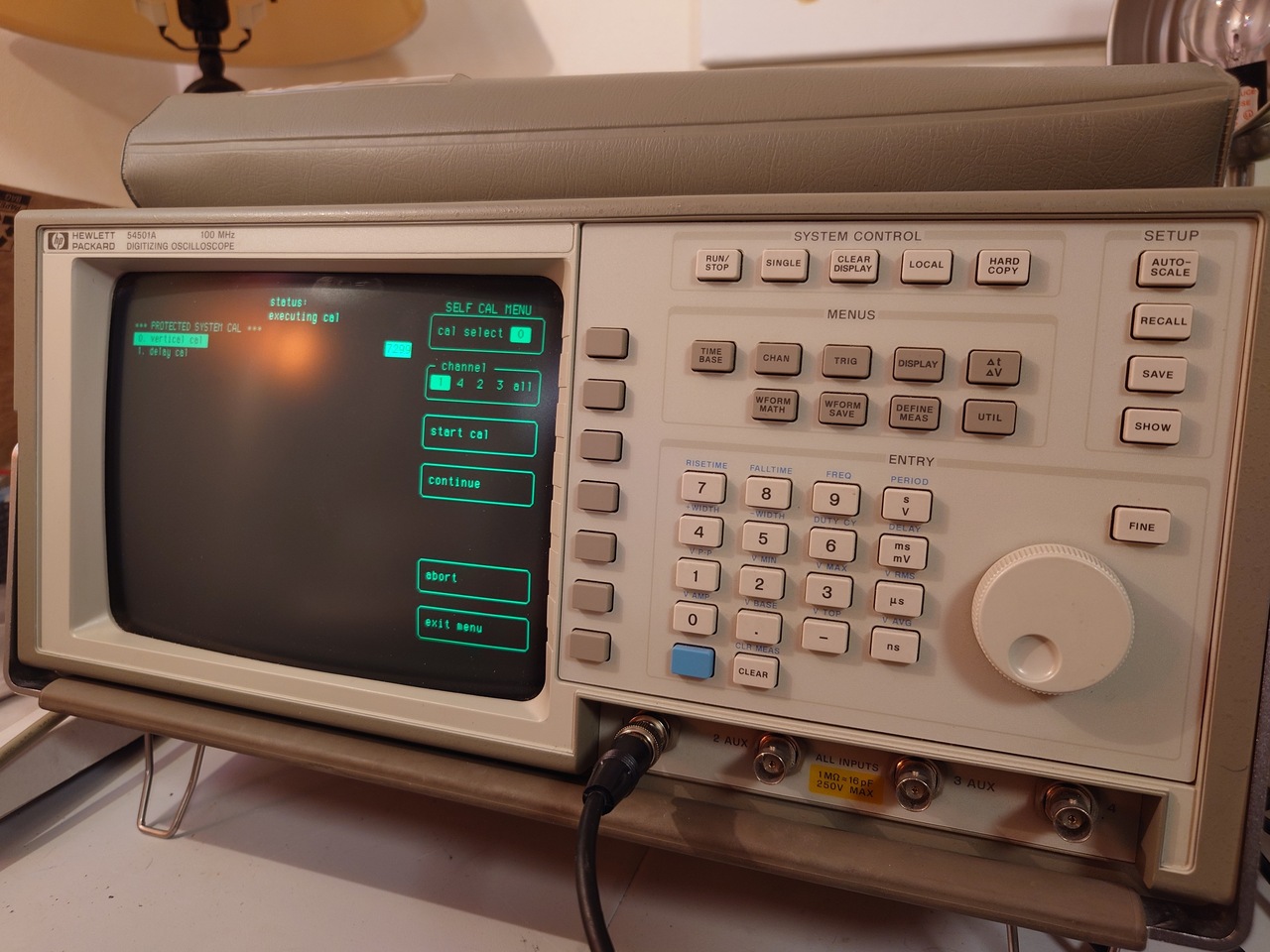
I picked up an oscilloscope at a recent hamfest in North Bend, Nebraska (held by the Pioneer Amateur Radio Club). It is a Hewlett Packard 54501A from 1990, which even at the time was the lowest end model of digitizing scopes that HP offered. The price in 1990 was $3,465[1], adjusted for inflation that's around $8,800 today. I happened to buy it for $50, so not bad, seeing as they go for >$120 on eBay these days I'm happy with my purchase.
As the 1990 HP "Test & Measurement Catalog" states:
The HP 54501A is a 100 MHz, 4 channel digitizing oscilloscope designed primarily for repetitive signal applications. It has all of the digitizing advantages of oscilloscopes much higher in price...
So as far as oscilloscopes go, this one is not particularly fancy or anything. However, it is now the only digital oscilloscope I own, so I'm happy with it! Especially since it can take in up to 250V on the input channels, I can use it for directly measuring power supplies and other power electronics, and for probing other equipment. Being an early digitizing scope, it only has a sample buffer of 501 points, which is... really bad. Basically it means there is no high resolution waveform zoom without averaging, which works fine for repetitive signals (as the brochure states), but is basically useless for anything which only happens once.
The Problem
Because of course there's a problem.
The only problem with this scope when I got it? It didn't display any waveforms at all! The self-tests were failing... which was discouraging. It turns out the battery-backed non-volatile RAM chip was dead. Ahh yes, one of these hateful Dallas clock chips from that era... this one is a Dallas DS1235YW-120. For those of you who don't know, Dallas clock modules are notorious for failing when left alone for a long time. These modules contain an internal lithium-ion battery which is designed to hold the data in the internal RAM for long periods of time. This particular chip has a rated lifespan of 5 years, so seeing as it's been... 35 years, that would explain why it's dead.
So, I tested running a self calibration and after about 10 minutes of sitting there calibrating, the scope popped to life! Of course, it would lose all its calibration data immediately when turned off, but at least I knew the scope worked!

The Solution
Because there's always a solution!
So in order to make it work, I would have to replace the Dallas NVRAM chip. I ordered an equivalent model on DigiKey, and then set to work disassembling the scope. Luckily, because it's designed to be serviced unlike most modern equipment, taking it apart was a breeze! The top panel unscrews with 10 screws, and then the back panel comes off and the mainboard slides right out. I got to work removing the offending chip with my desoldering gun.

Before I could replace it though, I had to wait for the other chip to arrive. In the meantime, I took some beauty shots of the board itself, as it's really pretty!

That large chip in the foreground is a Motorola 68000 CPU, running at 10 MHz. This performs all of the computerized functions of the scope. Interestingly, the 68000 was the basis for many early personal computers like the Macintosh 128k, Amiga, and Sega Genesis. Pretty cool, huh?[2]

When the clock chip arrived, I soldered in a header (product number 110-99-628-41-001000) and then stuck the new chip in it. I then put it all back together, and it works fine now! The calibration data is stored in memory even after a power cycle.
Conclusions
Overall, this scope is pretty functional for what I want to do with it, but the low sampling depth really hinders its usefulness in any measurement application I might want to try using it for. I wonder if it would be possible to modify it to have a higher sampling depth, after all RAM is cheap as chips these days in comparison to then. I think I might want to try dumping the ROMs next to the CPU to see what kind of stuff they contain, and investigate reverse engineering the board. But all of that is for the future, look out for more blog posts about it later I guess!
Also I definitely have not been posting more often ;P
Referenced from the HP catalog from 1990: https://hparchive.com/Catalogs/HP-Catalog-1990.pdf ↩︎
It was also used in other things, but it's a chip with a lot of history so I suggest looking into it if you want to learn more, I'm not exactly a 68k expert. ↩︎